AMWELL
Amwell is a B2C and B2B telehealth company that brings together technology and healthcare.

AI TRIAGE
CHALLENGE
Amwell patients need to quickly access appropriate care,
but the current service selection process creates barriers
to getting the right help. Limited descriptions leave
patients second-guessing their choices, and mismatched
care leads to delays, frustration, and potentially
inadequate treatment. Additionally, we see close to a 12% drop-off at various stages of the selection process due to an inability to determine the best service.
Patients are left wondering: Is the type of care I selected
actually best for my needs? I'm feeling anxious. Do I need
urgent care from a physician or maybe therapy? If I opt for
therapy, should I choose a psychiatrist or a therapist?
Patients need guidance, not more decisions to worry
about. How could we make the service selection easier
and more accurate for every patient, reducing stress and
improving outcomes?
SOLUTION
We decided to start the service selection process with a
conversation about the patient's symptoms or concerns.
Using AI to power the conversation, the application would
guide patients to appropriate services and gather
feedback to refine recommendations.
While the solution was conversational, it would not be a
chatbot in the conventional sense. The design needed to
give patients options without limiting their responses to
those options. It should never leave patients at a dead end
where drop-off was guaranteed. Finally, the primary
service recommendation should include other, less
prominent options for patients who felt more confident
about alternative choices.
While significant data is not yet available, we feel confident this solution is not only delighting patients, but also leading to considerably lower drop-off rates.
WHO DID IT
My Role
Consultant, Lead Product Designer
The Team
Principal Product Designer
Senior Product Designer
HOW WE DID IT
Process
We conducted competitive analysis to evaluate the success of other workflows. Did they offer a better solution? We also performed user research to understand how people think about AI, and specifically how they perceive a chatbot. Based on these insights, we determined the best direction to pursue, created wireframe flows, and followed with final designs.
CURRENT AMWELL SERVICE SELECTION
A patient enters the selection process and is given two choices: physical health or mental health. They must immediately self-diagnose to determine the best path forward. For example, if their issue is insomnia, they may assume it is a physical health problem. While it may be health-related, if the underlying cause is actually stress or anxiety, mental health care would be more helpful. If the patient chooses mental health, they must then decide between psychiatry and therapy. We have found that most users do not understand the differences between these specialties, and as a result, their selection may or may not be the most appropriate or helpful.

COMPETITIVE ANALYSIS
The first step in our process was examining how primary telehealth competitors handle service selection. Our analysis revealed several distinct approaches that informed our strategy.
Teladoc, our biggest competitor, coincidentally employs the same user flow as Amwell. Both platforms start directly with service selection, requiring patients to choose their care category upfront. The addition of a chatbot seemed like a good option, but was not as effective as it could have been.
Zocdoc takes a hybrid approach that caught our attention. The platform allows patients to either select a specific service or search using their condition or symptoms, providing flexibility in how users navigate to care.
Maven presented an interesting case study. While not a direct competitor across all services, there are meaningful overlaps with our offering. At first glance, Maven appears to let users book visits before determining their service needs. However, digging deeper revealed that their next step is actually hybrid as well. They combine direct service selection with symptom-based guidance.
The hybrid approach wasn't new to our team; we'd explored it previously. However, experiencing these implementations firsthand was validating and helped us see the concept in action across different platforms.

USER RESEARCH
AI Chatbots in Healthcare Survey
Whether to use AI was a critical decision that required understanding user sentiment toward the technology. Specifically, we needed to gauge how users felt about chatbots. While a chatbot seemed like an obvious solution that many at Amwell believed would best serve our users, we couldn't move forward without testing this assumption through user feedback. This survey was our first step in gathering those insights.
DEMOGRAPHICS
PARTICIPANTS - 20 total
AVERAGE AGE - 36 years old
GENDER
Woman - 16
Man - 4
EDUCATION
College Graduate - 11
Post-Graduate Coursework - 6
Some College - 2
EMPLOYMENT
Employed Full-time - 13
Student - 2
Employed Part-time - 2
ETHNICITY (TOP 3)
White - 9
Black or African American - 3
Middle Eastern or North African - 2
HOUSEHOLD INCOME
Over $150,000 - 6
$100,000-$149,999 - 3
$75,000-$99,999 - 4
MOST COMMON INDUSTRIES
Education - 5
Healthcare - 4
Technology - 2
SAMPLE QUESTIONS
1.
2.
3.
How much would you trust an AI chatbot to accurately direct
you to the right type of visit with the right type of doctor?
What concerns, if any, would you have about using an AI chatbot in your healthcare experience?
What, if anything, would make you feel more confident using AI in your telehealth care?
4.
5.
In a few sentences, tell us what has been the most frustrating or challenging part of using an AI chatbot.
Which of the following would you feel comfortable doing with an AI chatbot?
• Answering questions about my symptoms
• Getting help finding the right type of provider
• Getting reminders about upcoming visits
• Entering insurance or payment information
INSIGHTS
General Sentiment About Using Chatbots
Mixed to Positive Sentiment
Many respondents have used AI chatbots before and feel comfortable with them in some capacity.
Concerns
The most common concerns include accuracy, privacy, and the chatbot's ability to understand nuanced or complex medical concerns.
Trust Issues
People are hesitant to fully trust chatbots for making healthcare decisions, though they are more open to using them for simple tasks like appointment reminders.
Preferred Interaction Methods
Mixed Approach is Preferred
Most respondents prefer a mix of free text input and structured responses (pre-filled choices).
Why?
Users like free text for personalization but appreciate structured options for efficiency and clarity.
“
The only concern I would have with using an AI chatbot would be the possibility that I would get inaccurate information... The other concern would be privacy. I'd rather provide sensitive information to a person rather than an AI chatbot.
”
“
[AI chatbots have] been a great way to find all the information I need.
”
“
I think I wouldn't want to trust it completely to the point where it could be giving me the wrong direction. I would need to verify it somehow or make sure it's giving me the right person to talk to.
”
AI Chatbot vs AI-Enhanced Wizard UI A/B Test
Based on the results of the survey we explored what a hybrid approach could be. Using mock-ups of a chatbot, Option C, and a new hybrid “wizard,” Option N, we asked participants to compare the two across multiple criteria.
DEMOGRAPHICS
PARTICIPANTS - 20 total
AGE RANGE - 23 to 65
DEVICES USED
Mostly smartphones and computers; a couple used tablets
INDUSTRIES
Healthcare, Education, and some retired individuals
COMFORT WITH TECHNOLOGY
"Not at all comfortable" to
"Very comfortable"
TASK
When looking for care for your insomnia, you are presented with these screens.
Which screen is the most:
Trustworthy
Premium
Friendly
Understandable
Each criteria included both a ranking and an open-ended question asking participants to explain their reasoning.


RESULTS
Overall, Option N was more commonly preferred among participants. Throughout the testing sessions, participants consistently favored Option N, citing its clarity, modern aesthetic, and professional appearance as key strengths. The design seemed to instill confidence and trust, particularly important in healthcare contexts. However, Option C consistently earned praise for its more personal approach, with participants appreciating its conversational tone and familiar interface patterns.

CONCLUSION
The survey and A/B test results encouraged us to define use cases for both a chatbot and the hybrid approach. They both serve the needs of specific implementations, and the AI-enhanced wizard is appropriate for Amwell.
Free Text Chatbot
Concierge
"Tell me what you need—I’ll figure it out with you."
Best for
Exploratory use cases
Emotional expression (e.g. journaling, coaching)
Advanced users or internal tools
When users know what to ask
AI-Enhanced Wizard UI
Expert Assistant with a Checklist
"Here’s what we’ll do together—step by step, tailored to you."
Best for
Healthcare, finance, legal—where trust, clarity, and compliance matter
Early-stage users or high-stakes decisions
Clear, bounded workflows (e.g. routing, onboarding, symptom reporting)
WIREFRAMES
UI Templates


Flows
There are two entry points into AI Triage: a free text field and common symptom buttons. The symptoms were determined based on data from current telehealth visits. We identified two possible flows for the free text input and one for the buttons.
The two text input flows handle different scenarios: vague input ("I don't feel well") and multiple care options ("Insomnia"). The vague input flow takes patients through clarifying questions to identify their symptoms, while the multiple care options flow guides patients through questions that result in different types of care they can choose from. When patients use the symptom buttons, the resulting care recommendation is more direct and based on current use cases.

DESIGNS
As part of a larger initiative at Amwell, we developed a new design system to elevate the application's brand with an updated look and feel. The goal was to create a more premium experience while maintaining our friendly, approachable tone. Leveraging the new design system components alongside our wireframes, we quickly translated concepts into designs


RESULT

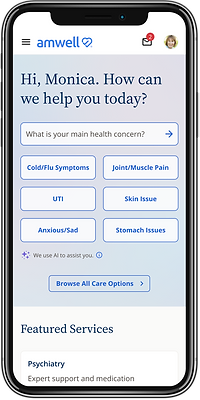
Our solution implements an AI wizard that guides patients to appropriate care while maintaining the flexibility of traditional service selection. The homepage features our hybrid approach. The AI wizard is prominently displayed with direct service selection available below for users who prefer the existing flow. This approach combines AI intelligence with patient autonomy, ensuring everyone finds appropriate care regardless of how they prefer to communicate their needs.
Two Entry Points, Bounded Workflow
The wizard offers two methods for patients to describe their needs:
Common symptoms - Shows frequently reported conditions based on historical data.
Free-text input - Patients can describe any symptom or concern in their own words.
Both paths utilize the same AI engine within a bounded workflow that ensures patients are guided through a structured decision tree to determine the most appropriate service.
Handling Different Complexity Levels
Straightforward cases like COVID symptoms immediately route to the correct service. In this case, urgent care for an immediate physician telehealth visit.
Complex cases demonstrate the AI's nuanced guidance:
"Insomnia" could lead to multiple services, but the AI recommends therapy based on the patient's specific context.
"I don't feel well" is too vague for immediate recommendations, so the AI asks clarifying questions to funnel down to the actual issue.
No Dead Ends Design
The system ensures patients always have a path forward. If recommended options don't fit their needs, patients can:
• Add their own details for AI reinterpretation
• Generate new queries or refined recommendations
• Access alternative service options alongside primary recommendations