AMWELL
Amwell is a B2C and B2B telehealth company that brings together technology and healthcare.
DEPENDENTS

CHALLENGE
We faced the challenge of addressing the limitations that prevented dependents, such as children under 18 and individuals unable to manage their own healthcare, from using the application for telehealth visits. A critical requirement was creating a system that allowed proxies to enroll dependents and manage their accounts, including updating key details like name, address, and insurance information. Additionally, the application needed to accommodate scenarios where multiple proxies shared responsibility for a single dependent’s healthcare, necessitating a secure and collaborative system to handle shared access and data management effectively.
SOLUTION
The project successfully developed a feature that empowered proxies to manage telehealth visits for dependents effectively. The solution enabled proxies to add dependents to their accounts and manage their profiles with ease, ensuring a streamlined experience. Additionally, the project supported shared responsibility by allowing multiple proxies to collaborate in the care of a single dependent. Ultimately, this initiative ensured that dependents could fully take advantage of telehealth services, enhancing accessibility and convenience for families and caregivers.
WHO DID IT
My Role
Lead Product Designer
Product Manager
Implementation Engineers
QA Engineers
HOW WE DID IT
Persona
Established UX Patterns
Amwell Design System

The Team
Resources
Process
As the product designer on the project, I was responsible for producing a new persona and creating the design assets. The team and I conducted reviews of these assets, and I incorporated feedback to refine them. Our collaboration spanned the entire project lifecycle, from initial requirements gathering to final release.

PERSONA
The persona "Mommy Malia” was developed based on an analysis of the application’s user demographic data, which revealed a significant increase in users aged 30 to 40 who use the application for their own healthcare needs and have children who could benefit from telehealth services. Mommy Malia represents a mother of two who works long hours as an accountant and navigates a busy, fast-paced life. She prioritizes efficiency and seeks to minimize the time and effort required to manage sick days, reflecting the challenges faced by many parents balancing professional and family responsibilities.

USER FLOWS
We designed user flows to establish intuitive and seamless interactions, ensuring a logical experience for users. These flows also served as a crucial communication tool for engineers, outlining the necessary functionalities for development.
A key focus was defining the entry point for users to initiate the process of adding a dependent while streamlining the experience for maximum simplicity. The most complex aspect of this flow involved integrating the concept of the existing proxy. We carefully considered how to structure communication between the existing proxy and Mommy Malia, ultimately leveraging Amwell’s email and messaging capabilities to facilitate the necessary interactions.
Beyond the add-a-dependent function, we also developed an edit flow with an emphasis on clarity and ease of use. Throughout our process, we consistently referenced the user persona as a guiding touchpoint, ensuring a user-centric approach in every decision.
ADD DEPENDENT
EDIT DEPENDENT

WIREFRAMES
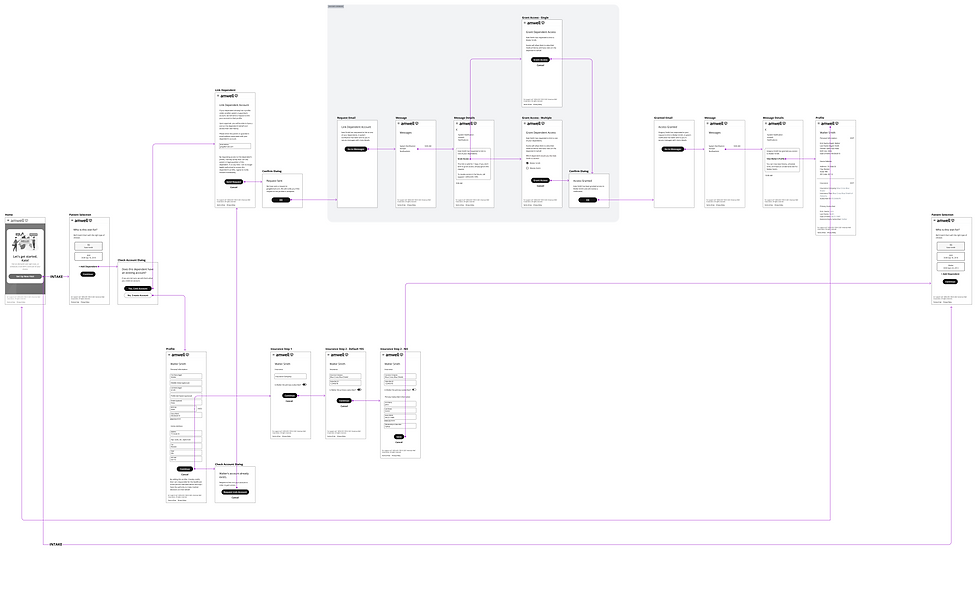
These wireframes functioned as the foundational blueprints for the designs, emphasizing usability, navigation, and content hierarchy. We crafted the copy and strategically positioned buttons (CTAs) and form elements, always considering Mommy Malia—her busy lifestyle and her need for simplicity and clarity.
By aligning the wireframes with the user flows, we brought the experience to life, allowing us to evaluate its effectiveness. Did the flows still hold up? Through careful analysis, we confirmed that they did.
ADD DEPENDENT
EDIT DEPENDENT


DESIGNS
Amwell provides a robust style guide and an extensive Figma component library. Leveraging these assets, along with established design patterns, we transformed the wireframes into polished designs ready for hand-off to engineering. Since user flows and wireframes had been shared with the engineering team early in the process, the transition was seamless, ensuring a smooth and efficient build with no unexpected challenges.

RESULTS
The project delivered a user-friendly, intuitive solution that addressed the unique needs of dependents and their proxies, making telehealth more accessible. The new feature was seamlessly integrated into the existing application, ensuring a smooth experience for users. The design prioritized simplicity and usability, enabling proxies to easily enroll and manage dependents' accounts.
The results were immediately evident upon release. In the first week alone, 9.4% of active users—2,075 out of 22,100—successfully added a dependent to their accounts, demonstrating both the demand for the feature and its effectiveness. This early adoption highlighted the feature's accessibility and the positive impact it had on expanding telehealth access to dependents.
